The Case
Why the Septuagint
Nearly every English Bible on a shelf today translates its Old Testament from the Masoretic Text, the Hebrew text preserved and vocalized by Jewish scribes in the Middle Ages, whose oldest complete manuscript dates to the eleventh century after Christ. That tradition is a monument of scribal care, and no serious translation can work without it. But it is not the only ancient witness to the Old Testament, and it is not the one the first Christians read.
The Bible of the Apostles
Beginning in the third century before Christ, Jewish scholars in Alexandria translated the Hebrew Scriptures into Greek. The result, called the Septuagint after the seventy translators of legend, became the Bible of the Greek-speaking Jewish world, and then of the early Church. When the New Testament quotes the Old, it quotes the Septuagint far more often than any other form of the text. When Matthew writes that ἡ παρθένος, the virgin, shall conceive, he is quoting Isaiah as the Septuagint renders it. When the Epistle to the Hebrews builds its argument that Christ came with a body prepared, it is quoting the Psalter as the Greek manuscripts preserve it. For the writers of the New Testament and for the Church of the first several centuries, East and West alike, the Septuagint simply was the Old Testament.
An older witness than it appears
Because the Septuagint is a translation, it was long treated as a secondary witness: useful where the Hebrew is obscure, suspect everywhere else. The Dead Sea Scrolls changed that judgment. Among the Hebrew biblical manuscripts found at Qumran, a thousand years older than the medieval Masoretic codices, are scrolls whose Hebrew text agrees with the Septuagint against the Masoretic Text. The Greek translators, it turns out, were often faithfully rendering a Hebrew text that really existed and that differed from the one the Middle Ages passed down.
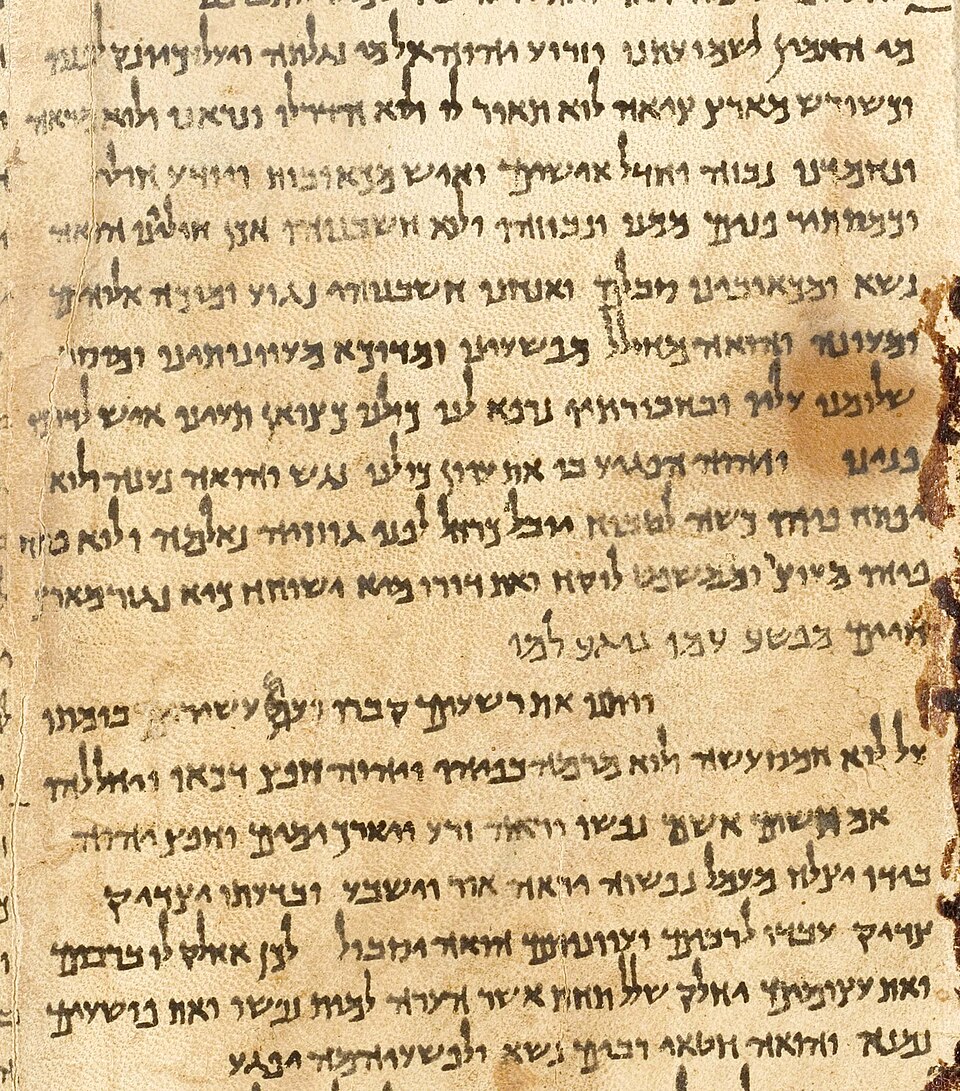
Three examples make the point concrete.
In Deuteronomy 32:43, the Septuagint's Song of Moses includes a line calling the heavenly beings to worship, the line the Epistle to the Hebrews quotes of Christ: “let all God's angels worship him.” The line is absent from the Masoretic Text. A Hebrew Deuteronomy scroll from Qumran Cave 4 contains it.
Deuteronomy 32:43 · Hebrews 1:6 · 4QDeutq
The book of Jeremiah in the Septuagint is roughly one-eighth shorter than in the Masoretic Text, with its chapters in a different order. Fragments of a Hebrew Jeremiah from Qumran follow the short Greek arrangement, evidence that the Septuagint translated a genuine, older Hebrew edition of the book.
Jeremiah · 4QJerb
In the Masoretic Text, Goliath stands six cubits and a span, over nine feet. In the Septuagint he stands four cubits and a span, a formidable six foot nine. The oldest Hebrew manuscript of Samuel, found at Qumran, agrees with the Greek.
1 Samuel 17:4 · 4QSama
None of this means the Greek is always right and the Hebrew always wrong; each tradition preserves readings the other has lost, and the Society's method weighs them case by case. It means something more basic: the Septuagint is a primary witness to the Old Testament in its own right, and in many books a witness to a Hebrew text older than the one behind every English Bible in print.
The gap on the shelf
Readers of English can buy the Septuagint in scholarly dress: academic renderings made for specialists, keyed to the Hebrew, designed for the seminar room rather than the lectern or the bedside table. What they cannot buy is what readers of the Masoretic tradition have had for four centuries: a complete, literary, reverent English Bible whose Old Testament is translated from the Greek. The Orthodox churches, which have always read the Septuagint, possess no such English Bible translated fresh from modern critical editions. Neither does anyone else.
That is the gap this Society exists to close: a translation of the whole Bible, with the Old Testament from the Septuagint in its best critical editions and the New Testament fresh from the Greek, made to the standard of the great English versions and made to be read.
For the textual detail behind this page, what the Greek text of Esther, Job, Daniel, and the Psalter actually preserves, continue to What It Recovers.