The Text
What the Septuagint Recovers
The argument for the Septuagint is not an abstraction. It lives in particular books and particular verses: places where the Greek text preserves something the familiar English Old Testament does not have, and where what it preserves was read as Scripture by the Church for centuries. Four examples, drawn from the books this Society's pilot work addresses first, show what is at stake.
Esther: the book with God in it
The Esther printed in English Bibles is famous for what it lacks: the name of God, which never appears in the Hebrew book. The Greek Esther is a different experience. It is longer by six substantial sections, and God is present throughout: named, addressed, and acting. Mordecai's opening dream frames the whole story as a conflict God will resolve. Esther's prayer before she risks her life is the spiritual center of the Greek book, and it does not exist in the Hebrew. She prays fasting, stripped of her royal splendor, pleading with the Lord of Israel. The decrees of the king are given in full. A closing interpretation returns to the dream and declares that these things have come from God.
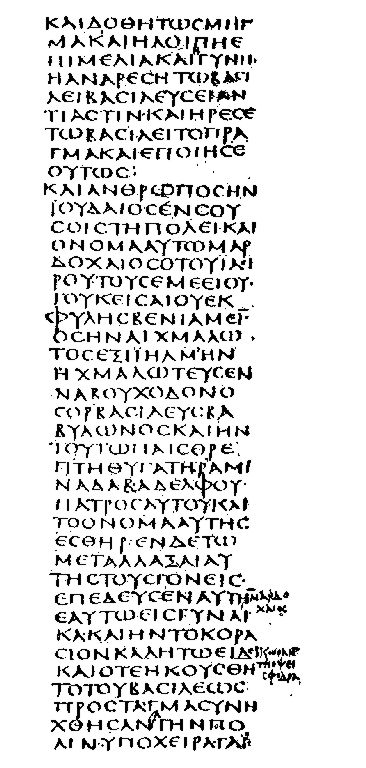
Since Jerome, English tradition has either omitted these sections or exiled them to an appendix of “Additions,” printed out of order and stripped of their narrative setting. The Society's translation will render the Greek Esther as the Greek Esther presents itself: whole, in order, with its prayers where its earliest readers found them.
Job: the ending English readers have never seen
The Greek Job differs from the Hebrew throughout. It is markedly shorter in the speeches, and its poetry moves differently. But its most striking difference comes at the very end. After the familiar epilogue, the Greek text continues:
γέγραπται δὲ αὐτὸν πάλιν ἀναστήσεσθαι μεθ᾿ ὧν ὁ κύριος ἀνίστησιν.
And it is written that he will rise again with those whom the Lord raises up.
Job 42:17a, Septuagint
The book of Job, in the form the early Church read it, ends with the resurrection of Job. A short appendix then identifies Job and his lineage. No complete English Bible carries this ending, because no complete English Bible translates the Greek Job. The Society's pilot translation of Job, working from the Göttingen critical edition, will.
Daniel: Susanna and the fiery furnace
The Greek Daniel opens with the story of Susanna: a righteous woman falsely accused by corrupt elders, vindicated when the young Daniel cross-examines her accusers and exposes their lie. It is one of the oldest courtroom dramas in world literature, a story preached by the Fathers as a figure of slandered innocence, and it stands at the head of Daniel in the Greek Bible. Within the furnace narrative of chapter three, the Greek text carries the Prayer of Azariah and the Song of the Three Young Men, the great canticle of the whole creation blessing the Lord, sung in Christian liturgies East and West from antiquity to this morning. English readers of the standard Old Testament have neither.
The Psalter the New Testament quotes
When the Epistle to the Hebrews places Psalm 40 on the lips of Christ, it reads: a body you prepared for me. That is the Psalter of the Greek manuscript tradition:
σῶμα δὲ κατηρτίσω μοι
but a body you prepared for me
Psalm 39:7, Septuagint (40:6 English) · quoted at Hebrews 10:5
The Hebrew instead reads ears you have dug for me. The Greek Psalter is the prayer book of the ancient Church: its numbering, its superscriptions, and in many places its wording differ from the Psalter English readers know, and its wording is the one the Apostles' generation prayed. A translation of the Septuagint restores that Psalter to English, not as a curiosity in a footnote but as the text itself.
Not additions, but the book
A pattern runs through these examples. English tradition treats the Greek text's distinctives as “additions” to a Hebrew original, material to be bracketed, appended, or dropped. The manuscript evidence is more complicated than that label suggests, and the reading experience of the early Church knew nothing of it. The Greek Esther was Esther; the Greek Job was Job; Susanna belonged to Daniel. This Society's translation begins from the Greek text as a text, translating what it says, in the order it says it, with the scholarly apparatus recording where and why the traditions diverge.
The pilot translations of Esther and Job are in preparation and will be published on this site with full scholarly annotation. To be notified, use the form on the home page. For how these judgments are made, see Method.